

Why Every Engineering Firm Needs a Leica 3D Scanner
- December 20, 2025
- 2 Comment(s)
Engineers know that numbers don’t lie. The problem? Traditional measurement methods sometimes do.
A steel beam arrives on site three inches off from the as-built drawings. The structural engineer swears the measurements were accurate. The fabricator has photos proving their work matches the specs. Everyone’s frustrated, and someone’s eating a $40,000 mistake.
Modern engineering projects move faster than ever. Margins of error shrink while client expectations grow. What looked like cutting-edge technology five years ago is now standard practice. Architects expect BIM models. General contractors demand clash detection reports. Clients want verifiable proof that what you designed actually fits the space.
3D laser scanning used to feel futuristic. Now it’s table stakes.
Leica scanners have become the equipment that serious engineering firms gravitate toward when accuracy, speed, and reputation matter. These aren’t gadgets that gather dust in the corner. They’re tools that quietly change how engineering gets done.
If your firm relies on measurements, coordination, and proof, a Leica 3D scanner isn’t optional equipment. It’s a strategic advantage that pays for itself faster than most technology investments.
So, What Exactly Is 3D Laser Scanning Anyway?
Laser scanning captures millions of spatial measurements per second using LiDAR technology. Here is a breakdown of how it works.
A Fancy Term for Capturing Reality
The 3D laser scanner shoots laser pulses at surfaces, measures how long they take to bounce back, and calculates precise XYZ coordinates for every point. The result? A point cloud—a dense collection of coordinates that creates a digital replica of physical space.
Engineers appreciate point clouds because they represent verifiable spatial data. You’re not estimating that ceiling height or guessing at that pipe offset. You have millions of measured points that document exactly what exists.
Consider the traditional approach: tape measures for rough dimensions, laser distance meters for longer spans, hand measurements transferred to sketches, then digitized into CAD. Maybe you photograph the site for reference. The process takes hours and relies on the measurer’s judgment about what matters.
A 3D scanner captures everything in minutes. Pipes, conduits, structural members, walls, ceilings, equipment, ductwork. If it exists in space, it shows up in the point cloud. How do you argue with a perfect copy of the real world?

Why Engineering Firms Care
Projects evolve between design and construction. Drawings represent intent, but reality has a way of diverging from plans. That HVAC duct shifts 6 inches during installation. The structural beam placement accommodates an unforeseen obstruction. The existing conditions differ from the renovation drawings.
These discrepancies cost money. Rework. Delays. Coordination meetings where everyone points at different drawings. Change orders that make clients question your competence.
Clients now demand accountability and proof. They want to see that your design actually fits their space before fabrication begins. They expect clash detection reports showing that mechanical, electrical, and plumbing systems won’t interfere with the structure or architecture. They ask for digital deliverables that integrate with their facility management systems.
Engineers need confidence, not guesswork. When you’re stamping drawings that affect structural integrity, fire safety, or building systems, “pretty close” doesn’t cut it. You need measurements you can defend.

Where Leica Quietly Pulls Ahead
Leica Geosystems built its reputation on surveying precision. Below are the details of how they accomplished that.
Accuracy That Makes Arguments Disappear
Leica Geosystems has been manufacturing measurement instruments since the 1920s, and that century of experience shows in their scanning technology.
Their scanners deliver sub-millimeter accuracy across typical engineering project distances. The BLK360 achieves 4 mm accuracy at 10 meters. The RTC360 maintains 1.9 mm positional accuracy at the same range. The ScanStation P50 holds millimeter-level accuracy beyond 100 meters.
These numbers translate to fewer redesigns, fewer clashes, and fewer awkward meetings where you explain why the design doesn’t match reality. Scan once, trust the data, move forward with confidence. When your model accurately represents existing conditions, coordination issues surface during design rather than construction.

Speed That Feels Like Cheating
Modern Leica scanners capture complete spatial datasets in minutes. The RTC360 scans a typical room in under 2 minutes using its VIS (Visual Inertial System) technology, which automatically handles registration between scan positions. What used to require a full day of field measurements now happens during a morning site visit.
Less field time means more design time. Project managers smile when they realize site visits no longer consume entire workdays. Engineers appreciate having afternoons free for actual engineering instead of transcribing field notes.
Reduced site revisits save real money. When you capture comprehensive spatial data for the first time, you’re not sending someone back to check that one dimension you forgot to measure. You’re not making educated guesses about clearances. The point cloud has everything.

Workflows That Speak Engineer
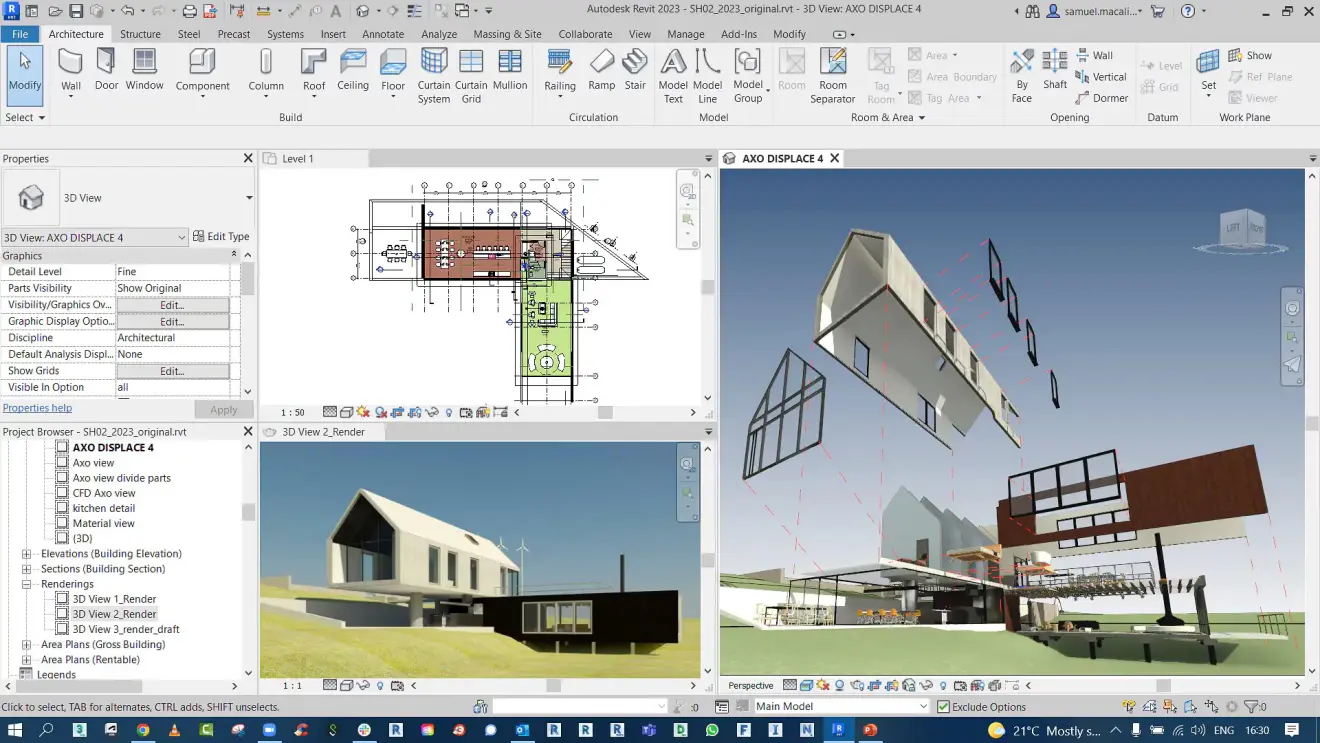
Leica scanners integrate directly with the software that software engineers already use—point cloud data exports to Revit, Navisworks, AutoCAD, Rhino, and SolidWorks. The company’s Cyclone software handles point cloud processing and registration. Register360 provides cloud-based registration for the RTC360. CloudWorx plugins bring point cloud data directly into design environments.
This ecosystem matters because engineers don’t want to learn new software ecosystems. They want measurement data that flows into existing workflows without friction. When your structural engineer can reference point cloud data directly in Revit, and your MEP team can check clearances in Navisworks, everyone speaks the same geometrical language.
Safety Without Bravado
Hazardous sites, high ceilings, unstable structures, and active industrial plants. Engineering work often happens in places where measurements require risk.
Climbing a ladder to measure ceiling heights in a chemical plant. Walking exposed steel beams to document connection details. Accessing bridge undersides to assess structural conditions. Standing near active roadways to capture transportation infrastructure.
A scanner captures these measurements from safe positions. The engineer stays on solid ground. The equipment absorbs the risk. Safety officers appreciate tools that eliminate exposure.
The Hidden Bonus: Reputation
Proposals that mention 3D scanning services win more often. When an engineering firm demonstrates they can provide reality capture, BIM models built from actual conditions, and clash detection before construction, they look like professionals who understand modern project delivery.
Clients notice which firms offer scanning. They recognize that these companies invest in accuracy and efficiency. In competitive-bid situations, the firm offering verifiable spatial data has an edge over competitors that still rely on traditional measurement methods.
The Leica 3D Scanner Lineup (and Which One Fits Where)
Here are the top Leica 3D scanners and what each one offers.
1. Leica BLK360 – The Pocket-Friendly Reality Recorder
The BLK360 weighs 1.6 pounds and fits in a backpack. It captures 360,000 points per second with integrated HDR imagery, delivering colorized point clouds that show both geometry and appearance.

This scanner excels at interior documentation. Architects use it for renovation projects. Engineers deploy it for building system surveys. The workflow is straightforward: mount on a tripod, start the scan via iPad app, wait two to three minutes per position, and move to the following location.
The BLK360 suits firms that need quick documentation without complicated workflows. It’s like carrying a photocopier for buildings. You point it at space, and you get a complete digital record.
Best applications include office buildouts, retail renovations, historical building documentation, and residential remodels. The scanner efficiently handles rooms, corridors, and small commercial spaces. It’s not designed for large industrial sites or long-range outdoor work, but for interior engineering projects; it delivers excellent value.
2. Leica RTC360 – The Workhorse Engineers Don’t Complain About
The RTC360 represents Leica’s mainstream scanner for professional engineering work. It captures 2 million points per second with automatic field registration using VIS technology. The system knows where each scan position relates to others, eliminating tedious manual registration.

This scanner shines on industrial sites, commercial buildings, infrastructure projects, and any application requiring BIM-ready outputs. Engineers appreciate the speed and reduced registration headaches. The scanner handles extensive facilities, complex mechanical rooms, structural documentation, and as-built surveys with equal competence.
The RTC360 integrates with Leica’s Register360 cloud service, allowing field crews to see registration results in real-time. If coverage gaps exist, the team knows before leaving the site. This alone prevents costly return visits.
Civil engineers use it for bridge inspections. Mechanical engineers deploy it for plant documentation. Structural engineers rely on it for renovation projects. The scanner doesn’t specialize in one application – it handles whatever engineering project you throw at it.
3. Leica BLK2GO – The Scanner With Legs
The BLK2GO is a handheld scanner that uses simultaneous localization and mapping (SLAM) technology. You walk through space while holding the device, and it builds a point cloud in real time. No tripod. No station setup. Just walk.

This approach transforms facility scanning. Complex buildings with multiple levels, tight corridors, equipment-dense rooms, and interconnected spaces that would require dozens of tripod setups become straightforward. You walk your regular site inspection route, and the scanner captures everything along the way.
The BLK2GO is ideal for facilities management, plant documentation, complex interior surveys, and any project where tripod setup time exceeds the actual scanning time. It captures 420,000 points per second while you move, building a continuous point cloud that covers the entire path.
The scanner works well for manufacturing facilities, hospitals, university campuses, and industrial plants. If your engineers spend significant time walking sites, the BLK2GO makes that walk productive. Where did the tripod go? You don’t need it anymore.
4. Leica BLK2FLY – The Drone That Stares at Buildings
The BLK2FLY combines autonomous drone flight with laser scanning. The system flies programmed paths around structures, capturing point clouds of facades, roofs, and other elevated features without the need for ladders, lifts, or scaffolding.

Engineers use it for high-rise documentation, roof inspections, facade surveys, and building envelope assessments. The drone maintains safe distances while capturing millimeter-accurate measurements. It handles structures that would otherwise require expensive access equipment or risky manual measurements.
The system is particularly well-suited to structural engineers assessing building conditions, architects documenting historic facades, and facility managers monitoring large portfolios of buildings. When ground-based scanning can’t see upper floors and hiring aerial lifts costs thousands per day, the BLK2FLY makes economic sense.
It’s a flying surveyor with better eyesight than any person climbing a ladder. The data comes back georeferenced and ready for analysis, without the safety liability of sending people up high.
5. Leica ScanStation P50 – The Long-Range Beast
The ScanStation P50 represents Leica’s heavy-duty scanner for large sites and extreme distances. It captures accurate point clouds beyond 1,000 meters and operates in temperatures from -20°C to 50°C. This scanner handles mines, quarries, extensive civil infrastructure, and any environment where distance matters more than portability.

Civil engineers rely on it for highway surveys, bridge documentation, and rail corridor mapping. Mining operations use it for volumetric calculations and site monitoring. The scanner delivers the accuracy and range needed for projects measured in hectares rather than square meters.
The P50 isn’t the tool for interior architectural work or tight spaces. It’s the choice when you need to scan a dam, document a highway interchange, or capture an entire industrial complex in a single campaign. Surveyors who work on harsh sites appreciate its durability and consistent performance.
Choosing the Right Leica 3D Scanner
Decision Matrix
Scanner | Best For | Typical Range | Project Scale | Relative Cost |
BLK360 | Interior documentation, renovation | 10-60m | Rooms, small buildings | Entry-level |
RTC360 | General engineering, BIM workflows | 0.5-130m | Buildings, industrial sites | Mid-range |
BLK2GO | Facility scanning, complex interiors | Walking distance | Multi-level buildings, plants | Mid-range |
BLK2FLY | Facades, roofs, elevated features | 35m scanning altitude | Building exteriors | Premium |
P50 | Civil infrastructure, mining, large sites | 1000m+ | Highways, quarries, campuses | Premium |
Real-World Scenarios
If your engineers spend more time walking facilities than designing, the BLK2GO eliminates tripod setup time and captures complete buildings in continuous workflows.
If you’re forever correcting subcontractor drawings and dealing with coordination issues, the RTC360 provides accurate as-built documentation that prevents clashes before construction.
If ladders make your safety officer nervous and accessing building exteriors costs thousands in lift rentals, the BLK2FLY autonomously captures elevated features.
If your projects span large areas and distance accuracy matters more than scanning speed, the ScanStation P50 delivers the range and precision needed for infrastructure work.
If you’re testing 3D scanning for the first time and need an affordable entry into reality capture, the BLK360 provides excellent documentation capabilities without a premium investment.
The right choice depends on project types, site conditions, and workflow requirements. Most engineering firms eventually acquire multiple scanners as different projects demand different tools.
The ROI That Makes the CFO Smile
Leica 3D laser scanners offer several benefits, including direct savings, indirect advantages, and a competitive edge.

Direct Savings
Eliminating measurement errors saves rework costs. When your model matches reality within millimeters, fabricators don’t manufacture incorrect components. Contractors don’t discover conflicts during installation. Change orders decrease.
Field time reductions compound across projects. A site visit that took six hours now takes ninety minutes. Multiply that across dozens of projects annually. The savings in labor hours alone often justify scanner acquisition within the first year.
Reduced site revisits eliminates travel costs, staff time, and project delays. When you capture comprehensive data on the first visit, you’re not scheduling return trips to verify measurements or check conditions. Remote team members can reference point cloud data without visiting sites.
Indirect Advantages
Faster project approvals occur when clients see accurate visualizations early in the design process. Point clouds and derived models demonstrate feasibility and identify potential issues before construction. Clients gain confidence that designs will work as intended.
Dispute resolution becomes straightforward when you have verifiable spatial data. If questions arise about existing conditions or as-built configurations, the point cloud provides objective evidence. You’re not relying on memories or photographs—you have measured proof.
Client satisfaction improves when projects proceed without surprises. When your engineering work demonstrates thoroughness and accuracy, clients refer you to their networks. Repeat business follows quality delivery.
Competitive Edge
Government projects and significant private developments increasingly require or prefer 3D documentation. RFPs mention reality capture, BIM deliverables, and digital twin integration—firms without scanning capabilities either partner with specialists or lose opportunities.
The engineering market is growing more competitive each year—differentiation matters. When two firms offer similar expertise and pricing, the one demonstrating advanced capabilities wins the project. 3D scanning signals that a firm invests in quality and efficiency.
Insurance carriers appreciate firms that reduce risk through better documentation. Some adjusters specifically ask about measurement methods and verification processes. Demonstrable accuracy can influence liability premiums and risk assessments.

Engineering Has Entered Its ‘No Excuses’ Phase
The engineering profession has moved past debating whether 3D scanning matters. The question now is which tools fit which workflows.
Firms that measure physical space for a living need measurement tools that match current expectations. Tape measures and laser distance meters still have a role, but they can’t deliver the comprehensive spatial data modern projects demand.
Leica scanners aren’t flashy. They don’t come with clever marketing gimmicks or unrealistic promises. They’re simply the correct answer for engineering firms that prioritize accuracy, efficiency, and professional credibility.
The technology has matured beyond early adoption phases. Workflows are established. Software integration is standardized. Training resources are available. The risk has been removed.
Your competitors are already scanning. Clients are expecting it. Projects require it. The future arrives whether firms prepare for it or not.
Future-proof your engineering practice or watch competitors pass by with capabilities you should have acquired years ago.
Ready to explore which Leica scanner fits your engineering workflow? Browse the complete lineup in Califf Surveying’s laser scanner collection, learn more about Leica’s scanning solutions, and see how reality capture changes the delivery of engineering.
2 comments on “Why Every Engineering Firm Needs a Leica 3D Scanner”
Choose our Airport Pickup Service Houston for seamless airport travel. We offer professional Airport Pickup Car Service with punctual drivers and clean vehicles. Our Airport Transportation Services ensure comfortable, secure, and efficient transfers, making every trip convenient for business and leisure travelers.
You have quickly thought up such matchless phrase?